Thai FDA Explains Food Label Date Codes for Consumers
The Thai FDA has published a guide explaining common food label date codes — EXP (expiry date), BB/BBE (best before), MFG (manufacturing date), and LOT (batch number). The article details what each abbreviation means, how they differ, and what consumers should watch for to ensure food safety and make informed choices.
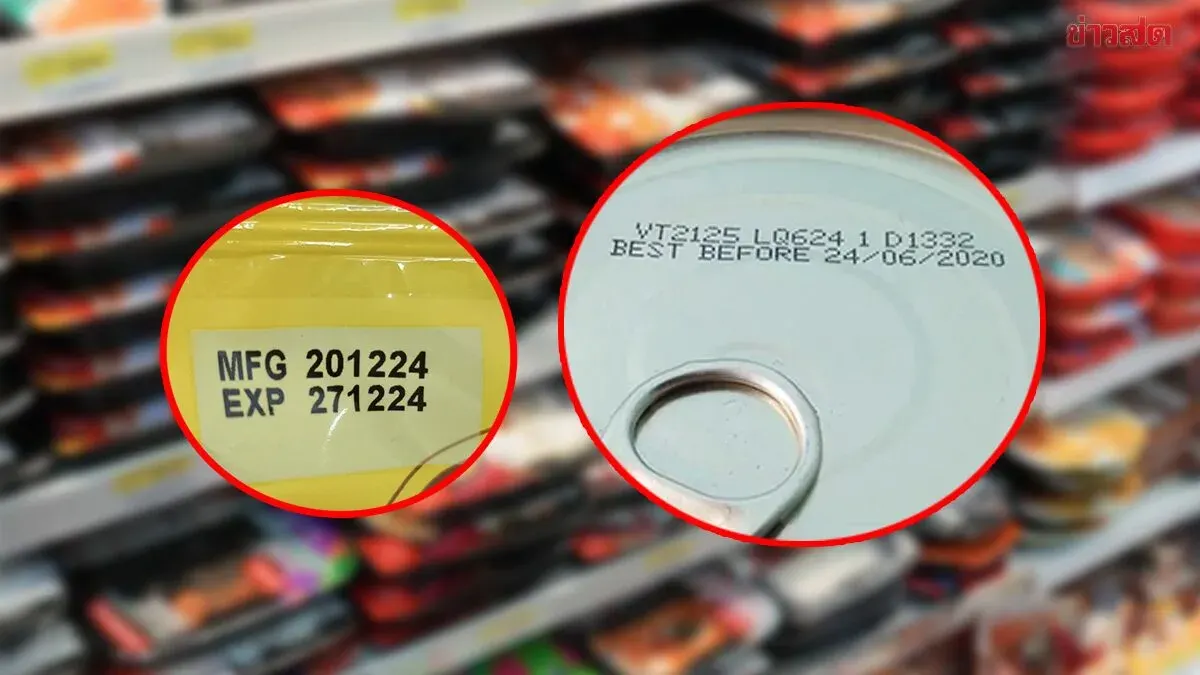
Can you still eat food past its expiry date? This article clarifies the English abbreviations and dates on food labels — EXP, MFG, BBF — explaining what each tells you and what to watch for. Check before you eat.
Whenever we buy food, medicine, cosmetics, or other products, the first thing we look at is the expiry date — a crucial detail for safety. But have you ever noticed or understood the labels on food? They come in various formats and differ from one another, such as EXP, MFG, BBF. The meanings, usage examples, differences, and precautions are not all the same, so understanding them correctly is essential.
EXP (Expiry Date) indicates the predetermined expiry date of a product, based on its stability, microbiological changes, quality, and associated risks. For example, if a product has passed its expiry date, it should not be consumed further. Freezing an expired product and cooking it later does not make it safe. Improper storage can also cause a product to expire before its stated date.
BB / BBE — Best Before / Best Before End indicates the date until which the food retains its expected quality and flavor. After this date, taste and quality may change, depending on factors such as water activity (Aw), pH level, manufacturing process (e.g., temperature and duration of microbial kill steps), packaging type and properties, and storage conditions.
MFG — Manufacturing Date is the production date, not the expiry date. It serves as baseline information so consumers know when the product was made. It helps with product storage and comparing lots of the same product. Benefits include checking product freshness — identical products stored the same way may have different remaining shelf lives — and traceability: if a problem arises, the manufacturing date and lot code can help identify related products.
However, the manufacturing date does not guarantee safety. Some products may be unsafe even if recently produced, due to unsanitary manufacturing, damaged packaging, or improper storage.
LOT / Batch — Production lot code. Lot codes are valuable for traceability. If a product has an issue, the lot code links back through production, packaging, storage, and distribution. For example, if one lot of snacks is contaminated, the manufacturer can identify the production date and facility, trace raw materials and processes, track distribution channels, and initiate an immediate recall to reduce consumer exposure.
Source: dis.fda.moph.go.th, inspection.canada.ca