Stingless Bee Farming Provides Easy Retirement Income
In Ratchaburi, Pairin Churod turned stingless bee farming into a thriving community enterprise after the honey helped her recover from a serious illness. Starting with just four hives, she expanded to over 1,000 colonies during the pandemic, creating a low-maintenance income source ideal for retirees and busy workers. The venture now promotes sustainable beekeeping using native silver-haired strains and encourages planting pollinator-friendly flowers.
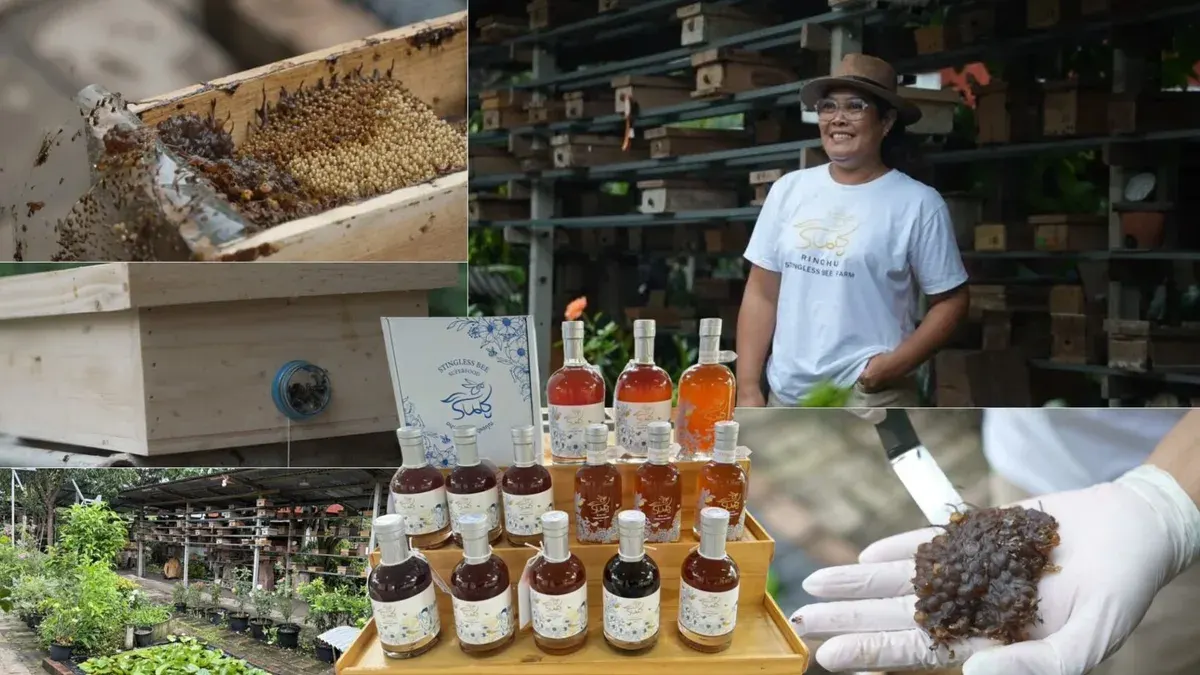
Stingless bees, locally called 'chanrong,' are gentle, stingless insects native to Thailand's tropical forests. Their honey boasts superior nutritional and medicinal properties, making them a popular economic insect.
Pairin Churod, president of the Rin Chu Chanrong Community Enterprise in Ban Bang Kluai, Chom Prathat Subdistrict, Wat Phleng District, Ratchaburi Province, once suffered a severe fever that nearly claimed her life. Her turning point came when she drank chanrong honey, which restored her health unexpectedly. Her previous career as a salesperson provided high income but required exhausting shifts around the clock until her body gave out. She resigned and returned to her hometown in Ratchaburi, sinking into depression and hopelessness for over two years before rallying to relearn walking. While practicing walking with a steel pole in front of her house, chanrong bees nesting in the pole frequently flew around her, biting her hair and eyebrows. She searched online for removal methods but instead found the phrase 'chanrong, the million-baht insect,' sparking her serious study and breeding of the bees.
One day, a speaker gave a knowledge-sharing session to village farmers. Pairin and her husband volunteered and started with four initial hives. They gradually accumulated more, not initially aiming for a full business because the household had other income sources. The turning point was the COVID-19 pandemic. Family occupations — vegetable selling and basket weaving — stalled. They turned to the over 100 chanrong hives left in their garden and began selling. Word of mouth spread, from orders of 2-5 hives to increasing bulk purchases. Now in its tenth year, they have propagated over 1,000 hives, selling some and currently maintaining about 600. They select the 'silver-haired strain,' a native breed that is easy to raise, hardy, and suited to all Thai climates.
"Stingless bee farming is a miraculous career. Salaried workers, people with no time, or retirees can raise them comfortably — no feeding, no grooming, no walking or bathing needed. The bees forage themselves; we just prepare food sources, mainly flower pollen. That means we plant flowers; the bees get pollen, we get fresh air, and natural water sources. That's all we need to provide," Pairin said. Chanrong bees survive at temperatures not exceeding 35 degrees Celsius. Where humans feel comfortable, the bees thrive. If not under tree shade, a roof against sun, rain, and dew is required. Once placed, hives must not be moved. A small area of just 1 ngan (400 sq m) can host 100 hives. They can be kept for household consumption or shared with neighbors, as the bees' foraging radius is 300 meters, allowing them to feed at adjacent properties, provided those areas are chemical-free.
"The food source is flowers. The bees know which flowers are toxic or safe. They prefer open flowers with visible pollen, such as 'Rak Raek Phop' (Wedelia trilobata). Coconut flowers, banana blossoms, and rubber trees provide good nectar, as do bougainvillea, champak, and lotus. Orchids are unsuitable due to low pollen," Pairin explained. For beginners, she recommends starting with 30-50 hives because expansion multiplies numbers: 30 becomes 60, 50 becomes 100. It creates a livelihood but warns against rushing. Rushing requires heavy capital to accumulate breeding stock; patience allows natural propagation or baiting with lower capital but more time.