Tourists Visit Wat Nong Kradee to See Giant Statue
Tourists and Buddhist devotees flock to Wat Nong Kradee in Uthai Thani province to see the world’s largest statue of Luang Pho Kleob, which stands 12 metres wide and 15 metres tall. The statue honors a revered monk famed for his miraculous utterances and legendary powers. The site has become an important religious and cultural landmark in the region.
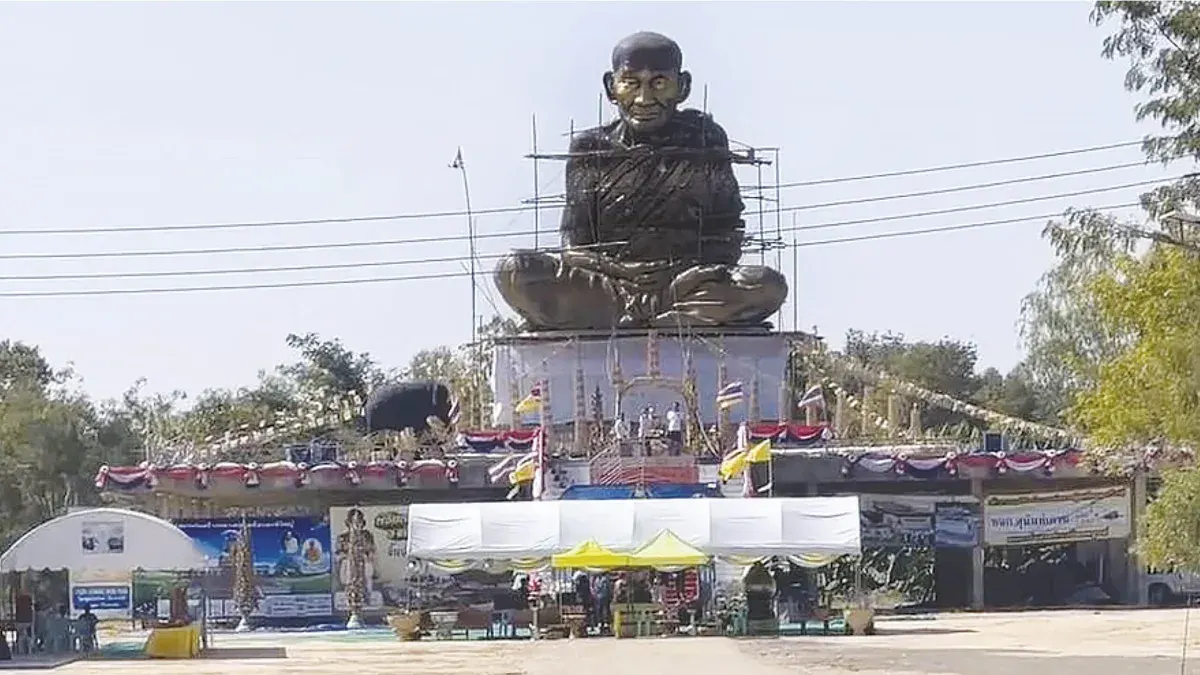
Buddhist followers and tourists visiting Thap Than District in Uthai Thani Province often go to Wat Nong Kradee (old) in Nong Yai Da Subdistrict, along the Thap Than–Sawang Aroem road, which is regarded as an important religious and cultural landmark. Inside the temple stands the largest statue of Luang Pho Kleob in the world, measuring 12 metres across the lap and 15 metres tall, with a grand and majestic appearance.
Luang Pho Kleob Sangwora Thammo, a renowned monk of Wat Nong Kradee, was famous for his powerful utterances; whatever he said would come true. He was honoured as the 'Deity of the Sakakrang River Basin'. Born in 1889 (BE 2432) in Ban Klong Chado, Thung Yai Subdistrict, Mueang Uthai Thani, he was of Chinese descent but Thai nationality. He entered monastic life in 1910 (BE 2453) at Wat Nong Tao, under the guidance of Phra Kru Uthai Thamwinit (Luang Pho Sin), who served as his preceptor, instructor in monastic discipline, and teacher of the scriptures. He received the nickname 'Sawaratthammo' and spent three rainy seasons studying magic and invulnerability with Luang Pho Sin at Wat Nong Tao.
Finding the monastery too crowded for meditation, Luang Pho Sin advised him to seek a quiet place to train his mind. Luang Pho Kleob discussed the Dhamma with Luang Pho Sin and asked to leave for further study. Luang Pho Sin told him that a skilled kasina practitioner resided near Lopburi, so Luang Pho Kleob set out with three companions. There he met a teacher, identified by elders as Luang Pho Kop of Wat Kao Salika, who possessed great magical knowledge at the time.
Luang Pho Kop told him, 'If you do not disrobe, I will teach you the magic; if you disrobe, I will not.' Luang Pho Kleob vowed to remain ordained for life, while his companions made no such promise and thus did not receive the teachings. He then spent six years studying kammathana meditation, fire kasina, and Khmer script used for yantra inscriptions under Luang Pho Kop, after which he left his teacher and wandered northward for several years, the exact destinations unknown, before returning to Wat Nong Tao. After only a few days, relatives from Wat Nong Ya Nang invited him to take up residence there.
Upon arriving, Luang Pho Kleob began constructing an ordination hall, but before its completion a conflict arose among the temple’s leaders, prompting him to say, 'If I am not here, nobody else can stay.' Afterwards it became difficult to find monks to reside, so he returned to Wat Nong Tao. When Wat Nong Khok lacked resident monks, he spent one rainy season there before moving to Wat Thap Than Wattanaram for three more seasons.
Later, when Wat Nong Kradee had no abbot, the local community invited him to assume leadership, and he remained there until his death in 1954 (BE 2497) at the age of 66, having completed 45 rains retreats. He was renowned for his sacred speech; villagers would make petitions by lighting three incense sticks or simply stating their wishes, and they would fulfil their vows with offerings such as white liquor, tamarind, or flower garlands.
The practice of making vows has become part of daily life for people of Uthai Thani and neighbouring provinces. When something is lost, a vow often brings it back; vows to stop rain frequently succeed; and many believe that vows protect travelers and lessen misfortune. Interested visitors can pay their respects at any time.