Minister Vows Rapid Fix for Foul Canal After Fish Kill
Deputy Minister Wacharaphol Khawakham said foul water and mass fish deaths in Raphiphat Canal 2, Pathum Thani, are expected to improve within one to two days. He ordered the Royal Irrigation, Land Development, and Fisheries departments to coordinate water‑management and quality‑restoration measures, including adding clean water, aeration, and microbial treatments. Officials aim to drain the flooded area by mid‑November, pending continued monitoring.
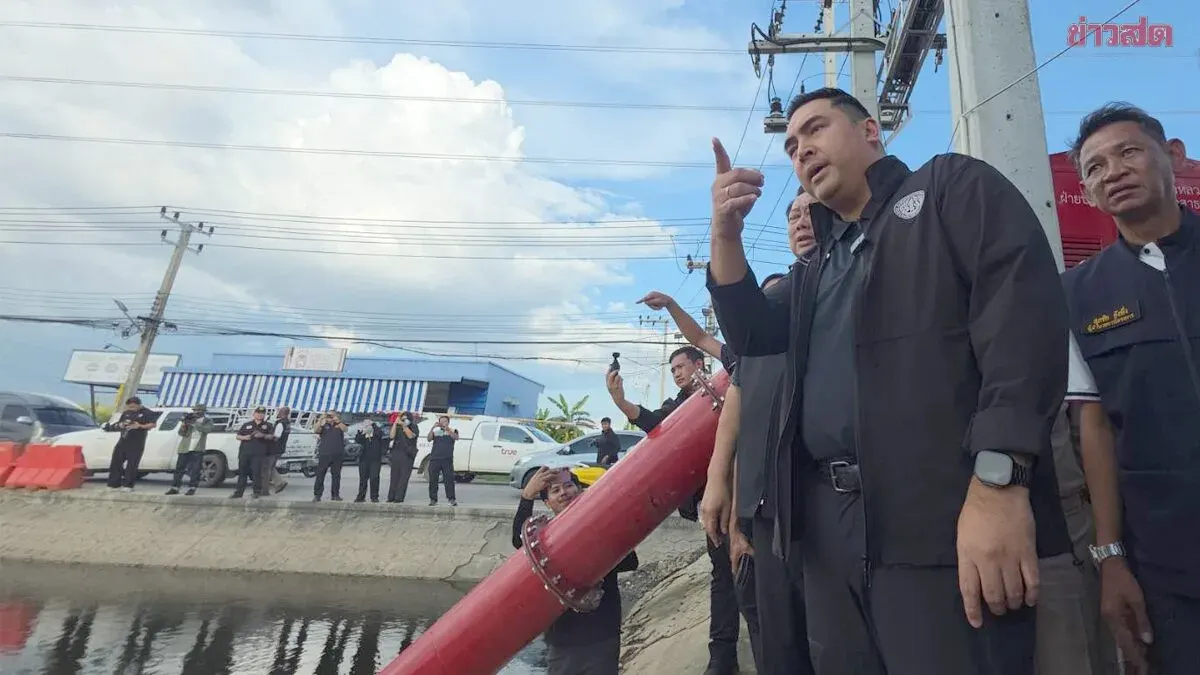
Wacharaphol Khawakham, the deputy minister for agriculture and cooperatives and MP for Udon Thani from the Pheu Thai Party, spoke about the foul water and fish deaths in Raphiphat Canal 2, Khlong Luang district, Pathum Thani. He said part of the cause is wastewater from flooded fields flowing into the canal, combined with high water levels in the Chao Phraya River that slow drainage and allow polluted water to accumulate. Confirming the cause of the fish deaths requires water‑quality test results, so the response must work on two fronts: water management and water‑quality restoration.
For water management, the authorities are adding good‑quality water to dilute the polluted flow while controlling outflow to match the capacity of downstream areas. For water‑quality restoration, they are increasing circulation, aerating low‑oxygen zones, and using microbial products recommended by academic agencies, with ongoing water‑quality monitoring.
He added that the Royal Irrigation Department has been supplying about 500,000 cubic metres of clean water per day, carefully regulating intake and discharge to keep the water level at the downstream control point below +1.80 metres above mean sea level, to avoid affecting homes and communities.
According to a field report dated 19 October 2069, water conditions in Canal 2 have been improving steadily since the problem first appeared on 15 October 2069, and are expected to continue improving over the next one to two days if the measures are implemented as planned. Water‑quality assessments, especially dissolved‑oxygen levels, will be reviewed again.
In summary, if there is no additional heavy rain, no extra inflow beyond the plan, and water levels in receiving basins remain favorable, the stagnant flood water in the target area could be drained gradually by mid‑November 2069. Recovery of water quality will depend on continuous testing.
Regarding the wastewater that must be diverted through other canals such as Canal 4, Wacharaphol has directed advance planning by integrating the Royal Irrigation Department, Land Development Department, and Fisheries Department. The irrigation department will provide water‑pushers to raise oxygen levels and suction dredges to remove sediment that has accumulated for over 50 years, installing them at various points. The Land Development Department has already distributed 120,000 litres of high‑efficiency microbial mixture (PD.6) into Canal 2 to alleviate odor and will produce an additional 20,000 litres per day for future monitoring sites.
Coordination with the irrigation department will also deploy water‑trucks carrying 6,000 cubic metres of water for distribution. On Friday, 23 October, the Fisheries Department will apply microbial strain PM.1 to treat wastewater, improve water quality, and reduce accumulated organic substances in stagnant water or fish‑rearing ponds, and strain PM.2 for use in aquaculture hatcheries, nurseries, and commercial grow‑out ponds, often mixed with molasses or glucose syrup and animal feed, aerated to serve as probiotics that enhance water quality and lower disease risk. These will be loaded onto the irrigation department’s water trucks and dispatched to Canal 2 and other future discharge points to restore water conditions. Overall, if rain does not intervene, the flood water could be fully discharged by mid‑November.