Anutin Confident Thailand GDP Will Exceed 2.1% This Year
Deputy Prime Minister Anutin Charnvirakul says Thailand's GDP growth will exceed the 2.1% forecast, citing surging foreign investment and exports. He has ordered a review of economic data and plans to consult business groups before announcing a revised figure. Anutin also outlined a strategy to position Thailand as an ASEAN logistics hub rather than a low-cost manufacturing base.
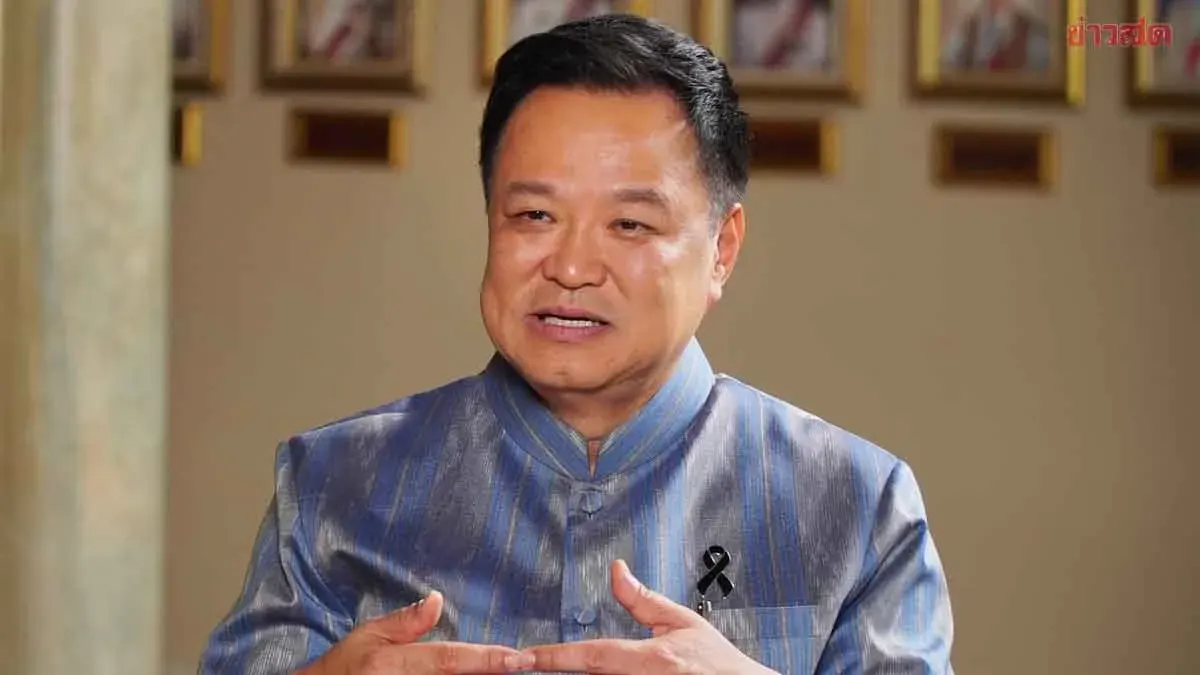
Speaking on the NBT program "Talk with PM Anutin" on October 24, 2026, Deputy Prime Minister and Interior Minister Anutin Charnvirakul addressed Thailand's GDP projection of 2.1% for this year. After observing improved figures in investment, exports, employment, and tax revenue, he directed the Office of the National Economic and Social Development Council to re-examine the details. Economic indicators now reflect a picture different from earlier estimates, particularly foreign investment in the first half of the year, which received data showing values roughly 30% higher than all of last year, while exports expanded more than 20% and at one point neared 25%.
The government also sees positive signals from increased corporate and personal income tax collections, plus money circulation from economic stimulus measures. Anutin questioned how the Thai economy could still grow only 2.1% if all key variables are moving upward simultaneously. "Therefore, Thailand's GDP this year is certainly not 2.1%," he stated.
Anutin said he had asked the NESDC to review calculation methods, assumptions, and data before reporting back that the overall picture has genuinely improved. The agency is now assessing how much to revise the figure upward and will consult with the Thai Chamber of Commerce, the Federation of Thai Industries, and relevant business sectors before announcing new numbers. He emphasized the importance of GDP figures because they affect confidence and financing costs; if Thailand is categorized among low-growth countries, it could limit investment opportunities, while improved figures could help fundraising and foreign investor decisions.
Anutin added that investment is another area the government wants to accelerate. Government trips abroad aim to increase trade, investment, and new cooperation, positioning Thailand as a potential partner rather than a country seeking assistance. The government expects to advance trade agreements with multiple markets including the United States, Europe, Central Europe, the United Arab Emirates, and Central Asia, while visits to Australia and New Zealand have helped remove some barriers from existing agreements and opened paths for continued new cooperation.
Anutin said he has repositioned Thailand for foreign investors: Thailand should not compete on cheap labor, cheap electricity, or accepting assembly work for mere wages. Instead, it must sell readiness in human resources, transport systems, logistics, markets, and regional supply chain connectivity. "You don't come to Thailand to find cheap labor; you're in the wrong place if you come for that," he said.
Thailand has advantages from a transport network spread throughout the region, with sea outlets on both sides plus road, rail, air, and sea networks. Investors using Thailand as a base can access not only the domestic market of about 70 million people but also connect to the ASEAN market of roughly 700 million people.
The government also believes infrastructure investments over the past 10-20 years are starting to yield economic returns, including dual-track railways, high-speed rail, and networks prepared to connect Nong Khai, Laos, southern China, down to the southern region and linking with Malaysia, giving Thailand potential as a multi-directional distribution hub.
Regarding energy, despite Middle East conflicts creating pressure on oil prices, Thailand has not yet...